ACCIDENT RECOVERY TOWING CHICAGO | 24/7 CRASH TOWING & IMMEDIATE RESPONSE
JUMP STARTS.LOCKOUTS.FLAT TIRES.FUEL DELIVERY & MORE
If you need accident recovery towing in Chicago, call (872) 713-6299. We are available 24/7 for collision towing, flatbed accident towing, winching, damaged-vehicle transport and roadside recovery throughout Chicago and nearby suburbs.

24/7 EMERGENCY SERVICE
15-30 Min
Avg Response
LICENSED & ENSURED
NO HIDDEN FEES
LOCAL EXPERT OPERATORS
ACCIDENT RECOVERY TOWING CHICAGO | 24/7 CRASH TOWING & IMMEDIATE RESPONSE
JUMP STARTS. LOCK OUTS. FLAT TIRES. FUEL DELIVERY & MORE.
24/7 Emergency Service
15-30 Mins
Avg Response
Fully Equipped & Professional
Trusted By Industry Experts
If you need accident recovery towing in Chicago, we are available 24/7 for collision towing, flatbed accident towing, winching, damaged-vehicle transport and roadside recovery throughout Chicago and nearby suburbs.
WE DO
MORE THAN
JUST TOWING

TOWING
ROAD SIDE ASSISTANCE
JUMP START SERVICE
FUEL DELIVERY
LOCK OUT SERVICE
FLAT TIRE SERVICE

AND MORE!
WE DO MORE THAN JUST TOWING
TOWING
ROAD SIDE ASSISTANCE
JUMP
START
FUEL DELIVERY
LOCK OUT SERVICE
FLAT TIRE SERVICE
AND MORE!
WHAT ACCIDENT RECOVERY TOWING INCLUDES IN CHICAGO
Accident recovery towing is the safe removal, recovery and transport of a vehicle after a collision, rollover, off-road incident or other crash. It can include flatbed loading, wheel-lift towing, winching, repositioning a damaged vehicle, and delivery to a repair shop, storage location, insurer-designated yard, or another location you request.
We handles light-duty, medium-duty and heavy-duty accident recovery. Our fleet includes flatbeds, wheel-lifts, heavy-duty equipment and winch or recovery units, with AWD-safe equipment for vehicles that should not be towed with drive wheels rolling.
What to do right now
Check for injuries and call 911 if anyone may be hurt.
Move to a safe location if you can do so without risking further injury.
Turn on hazard lights and set out warning devices if available.
Do not accept a tow from a truck you did not call.
Ask where your vehicle will be taken and keep the tow paperwork.
What accident recovery towing includes in Chicago
Accident recovery towing is the safe removal, recovery and transport of a vehicle after a collision, rollover, off-road incident or other crash. It can include flatbed loading, wheel-lift towing, winching, repositioning a damaged vehicle, and delivery to a repair shop, storage location, insurer-designated yard, or another location you request.
Immediate Response Towing Chicago handles light-duty, medium-duty and heavy-duty accident recovery. Our fleet includes flatbeds, wheel-lifts, heavy-duty equipment and winch or recovery units, with AWD-safe equipment for vehicles that should not be towed with drive wheels rolling.
Services included after a crash
Collision towing: Safe removal of wrecked, undrivable, or damaged vehicles.
Flatbed accident towing: Ideal for vehicles with wheel, suspension, axle, airbag or undercarriage damage.
Winching and vehicle recovery: Recovery for vehicles stuck in snow, mud, ditches, medians or difficult positions.
Accident repositioning: Careful repositioning before loading when a vehicle is blocked, jackknifed or partially off the roadway.
Damaged vehicle transport: Transport to a body shop, mechanic, storage facility, insurer-designated location or your requested destination.
Debris and fluid-cleanup coordination: We coordinate with appropriate responders or property managers when cleanup is needed.
Heavy-duty accident recovery: Recovery support for box trucks, commercial vehicles and larger vehicles when equipment and staffing allow.
For immediate emergency towing, see our 24/7 emergency towing in Chicago service page
Light-Duty, Medium-Duty and Heavy-Duty Accident Recovery Towing in Chicago
Immediate Response Towing Chicago provides accident recovery towing for passenger vehicles, SUVs, vans, motorcycles, commercial vehicles and larger vehicles across Chicago and nearby suburbs. Call: (872) 713-6299 for 24/7 accident recovery assistance.
| Towing Category | Vehicles Typically Covered | Common Accident Situations | Recommended Equipment | Recovery Services |
|---|---|---|---|---|
| Light-Duty Accident Recovery | Cars, sedans, hatchbacks, coupes, small SUVs, motorcycles and small vans | Front-end damage, rear-end collisions, side-impact crashes, flat tires after a crash, disabled vehicles in travel lanes or parking areas | Flatbed tow truck, wheel-lift tow truck, AWD-safe equipment | Collision towing, flatbed loading, damaged-vehicle transport, winching when needed, transport to a body shop, storage location or requested destination |
| Medium-Duty Accident Recovery | Larger SUVs, full-size vans, passenger vans, small box trucks, delivery vans and smaller commercial vehicles | Rollovers, jackknifed vehicles, vehicles disabled in tight urban streets, commercial-vehicle collisions, vehicles needing repositioning before loading | Flatbed or wheel-lift with higher capacity, winch/recovery unit, appropriate rigging | Accident repositioning, winch-out recovery, damaged commercial vehicle transport, secure loading, transport to a repair facility or storage yard |
| Heavy-Duty Accident Recovery | Box trucks, semi-trailers where applicable, buses, large commercial vehicles, construction vehicles, and other heavy vehicles | Major collisions, overturned commercial vehicles, jackknifed trucks, roadway blockages, off-road or ditch recovery, complex recovery scenes | Heavy-duty wrecker, heavy-duty recovery unit, winch lines, recovery rigging, specialized equipment | Heavy-duty winching, vehicle extraction, uprighting or repositioning when safely possible, commercial vehicle recovery, coordinated transport |
OUR CHICAGO ACCIDENT RECOVERY TOWING SERVICES
24/7 Professional Collision Towing & Vehicle Extraction in Chicago & Suburbs
Collision Towing & Scene Removal
What it is:
Safe, immediate removal and clearance of wrecked or undrivable vehicles involved in traffic collisions across Chicago roadways.
When you need it:
Vehicle is disabled following a highway or street collision.
Steering, suspension, or drive wheels are damaged or locked.
Police or traffic emergency services require rapid scene clearance
How we help:
Rapid 24/7 dispatch with specialized recovery equipment.
Direct coordination with law enforcement and emergency responders on scene.
Safe loading and transport to prevent additional post-crash damage.
What to expect:
Complete pre-tow written disclosure and clear destination tracking.
Professional handling by certified, experienced recovery operators.
Direct transport to your chosen body shop, yard, or home.
Can I choose where my car is towed after a crash in Chicago?
Yes, in most non-impound situations, Illinois law allows you to specify your preferred destination, such as your home, a local body shop, or an insurance-approved facility, before towing begins.
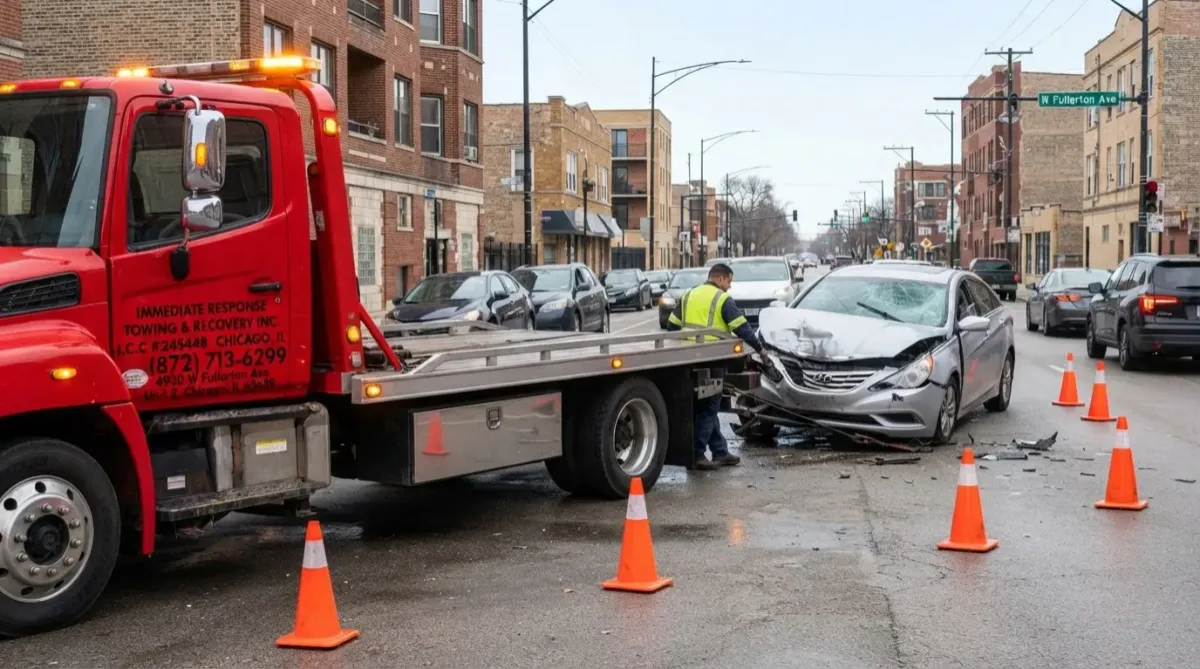
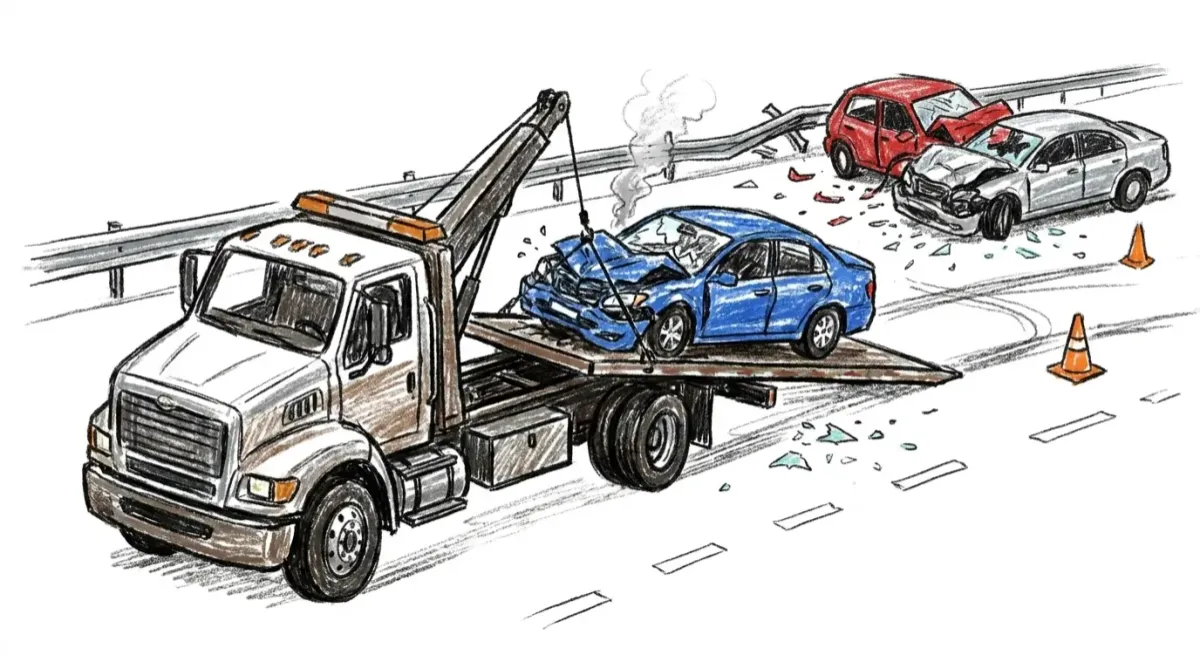
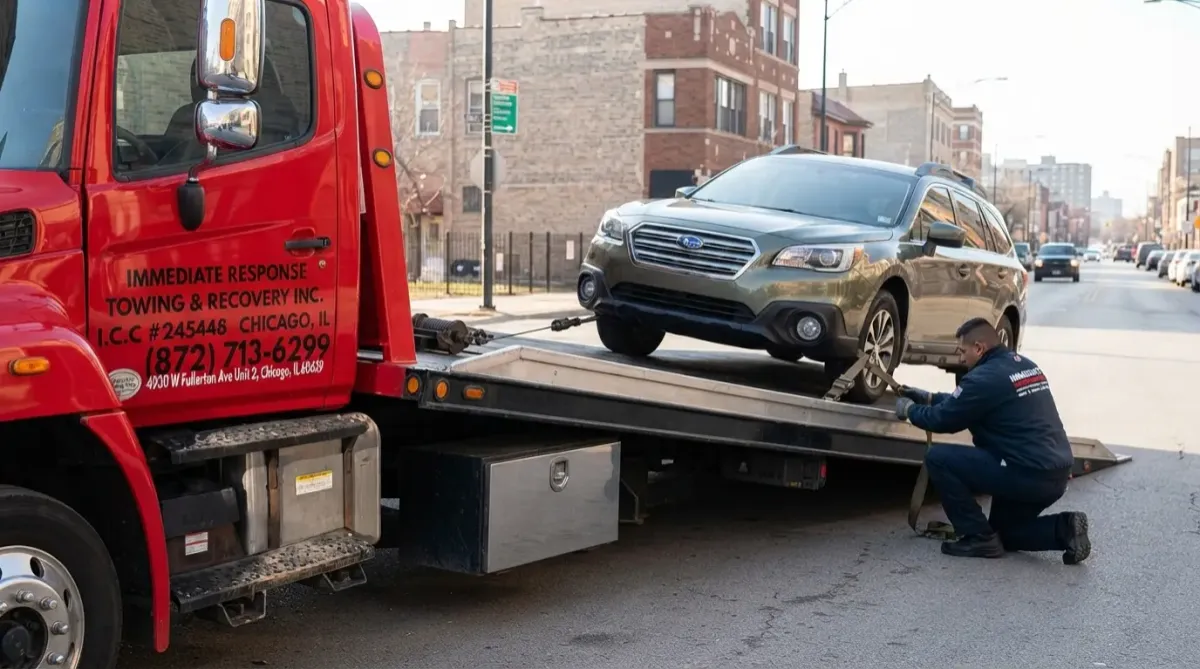
Flatbed Accident Towing
Request flatbed recovery for your vehicle now.
Flatbed Accident Towing
What it is:
Damage-free flatbed transport designed specifically for severely compromised vehicles, luxury models, and all-wheel-drive (AWD) systems.
When you need it:
Vehicle has severe wheel, axle, suspension, or undercarriage damage.
AWD, 4WD, lower-clearance, electric (EV), or hybrid vehicles.
Airbags deployed or structural frame compromised in a crash.
How we help:
Full-vehicle flatbed loading keeping all four wheels off the pavement.
Specialized rigging to secure damaged vehicles without causing frame strain.
Manufacturer-compliant towing procedures for EVs and AWD systems.
What to expect:
Maximum protection against secondary road or drivetrain damage.
Smooth hydraulic deck operation for easy loading at the crash site.
Secure tie-down points for safe highway transit.
Why is flatbed towing required for AWD or electric vehicles after an accident?
Flatbed towing keeps all four wheels off the ground, which prevents severe transmission, drivetrain, or electric motor damage caused by towing with drive wheels rolling on the pavement.
Winch-Out & Vehicle Extraction
What it is:
Heavy-duty winch and recovery services to extract vehicles stuck in dangerous positions off the roadway or in severe weather.
When you need it:
Vehicle slid off the road into a snowbank, ditch, mud, or median.
Vehicle stuck on high curbs, embankments, or tight alleyways.
Winter ice crashes on Chicago expressways and side streets.
How we help:
High-capacity hydraulic winch lines and specialized snatch blocks.
Controlled multi-angle pull technique to minimize vehicle damage.
Safe repositioning onto stable ground before flatbed loading.
What to expect:
Calm, precision extraction executed by trained recovery specialists.
Thorough undercarriage and wheel inspection before road transport.
Scene safety setup with hazard lighting and traffic control.
Will winching damage my vehicle if it’s stuck in a ditch or snowbank?
No. Our operators use precision multi-angle rigging, soft straps, and controlled hydraulic winching to safely extract your vehicle without causing structural or cosmetic frame damage.
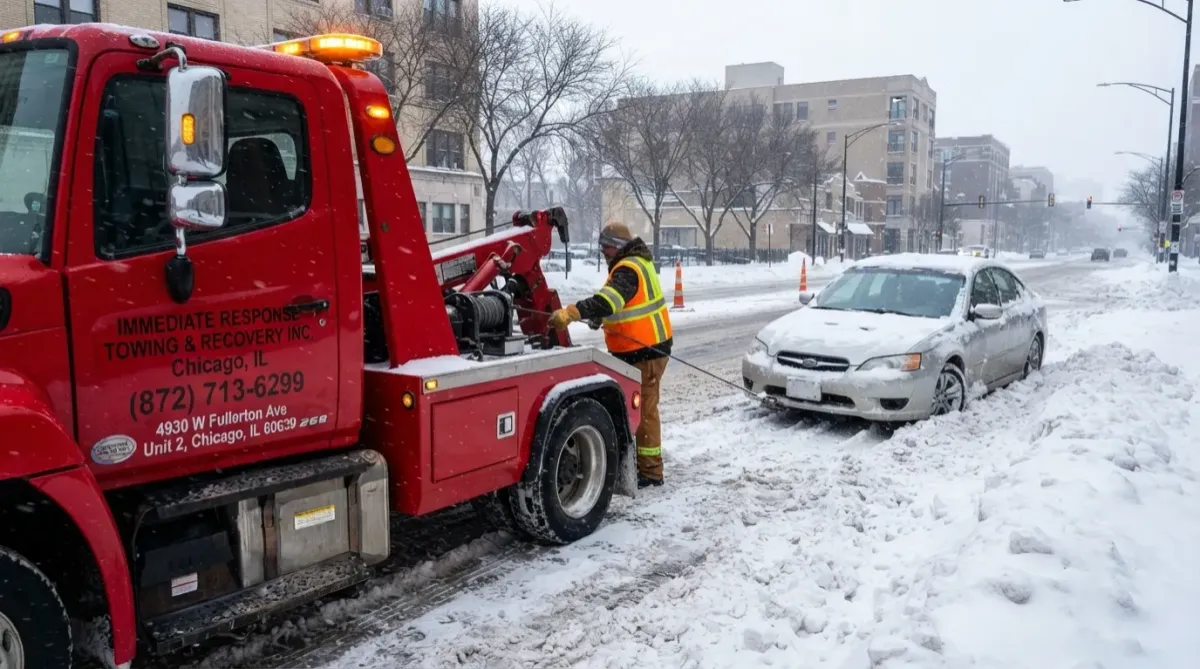
Winch-Out & Vehicle Extraction
Stuck in a ditch or snowbank? Call for winch recovery.
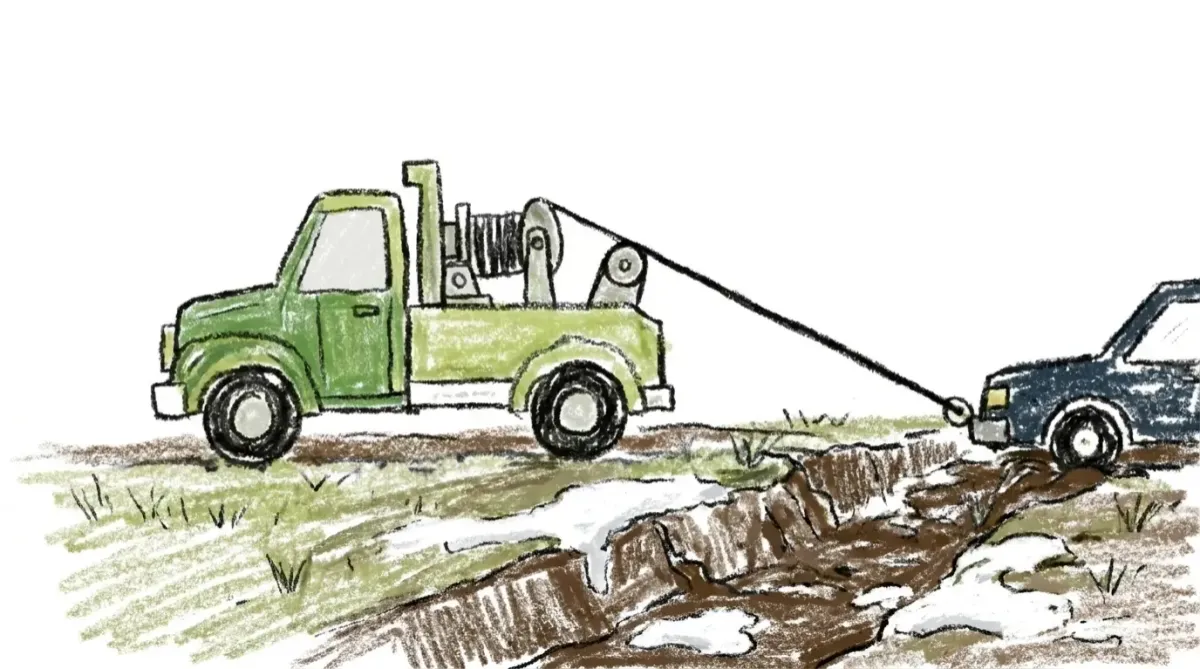
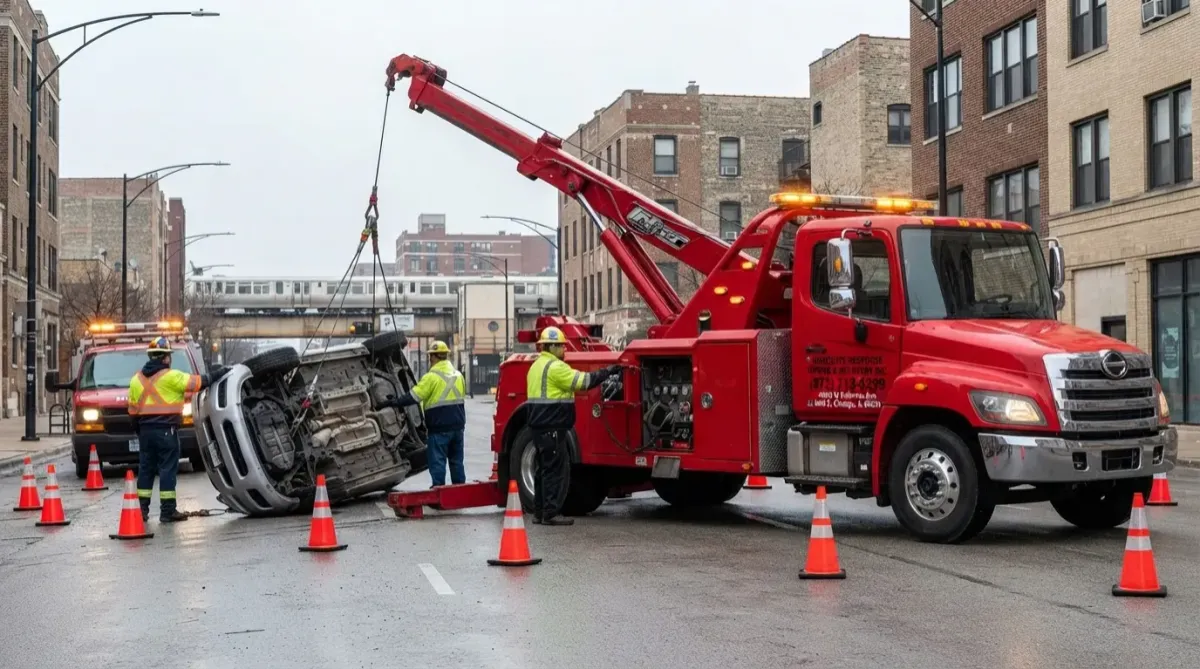
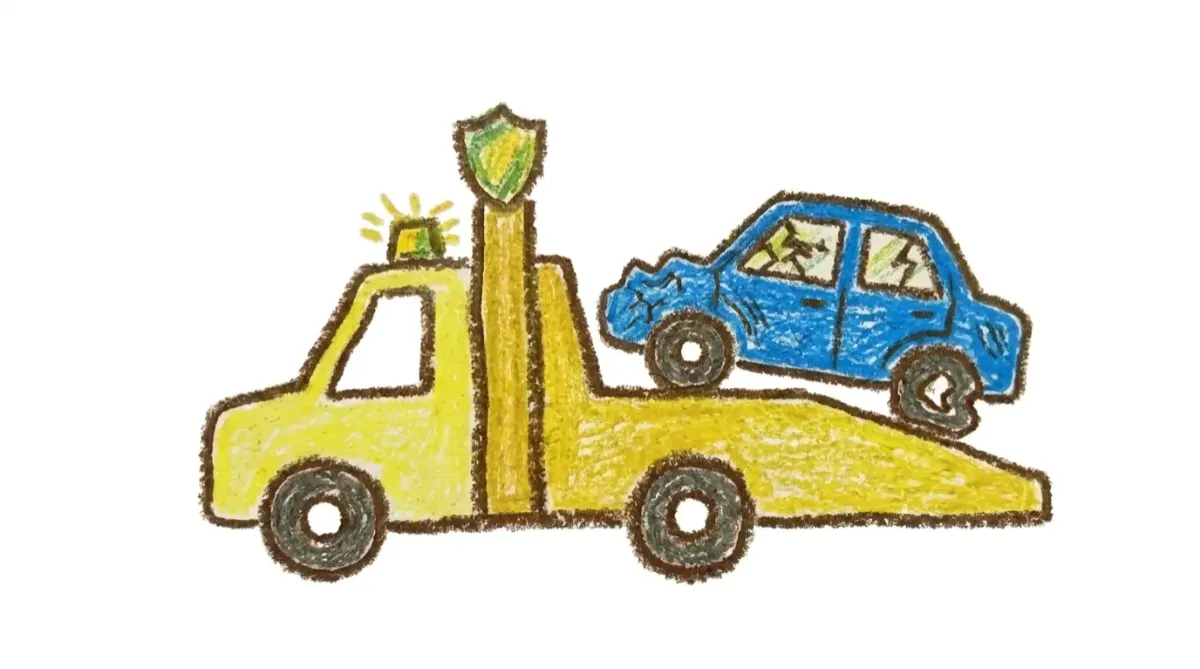
Accident Repositioning & Uprighting
Contact our recovery team for complex vehicle repositioning.
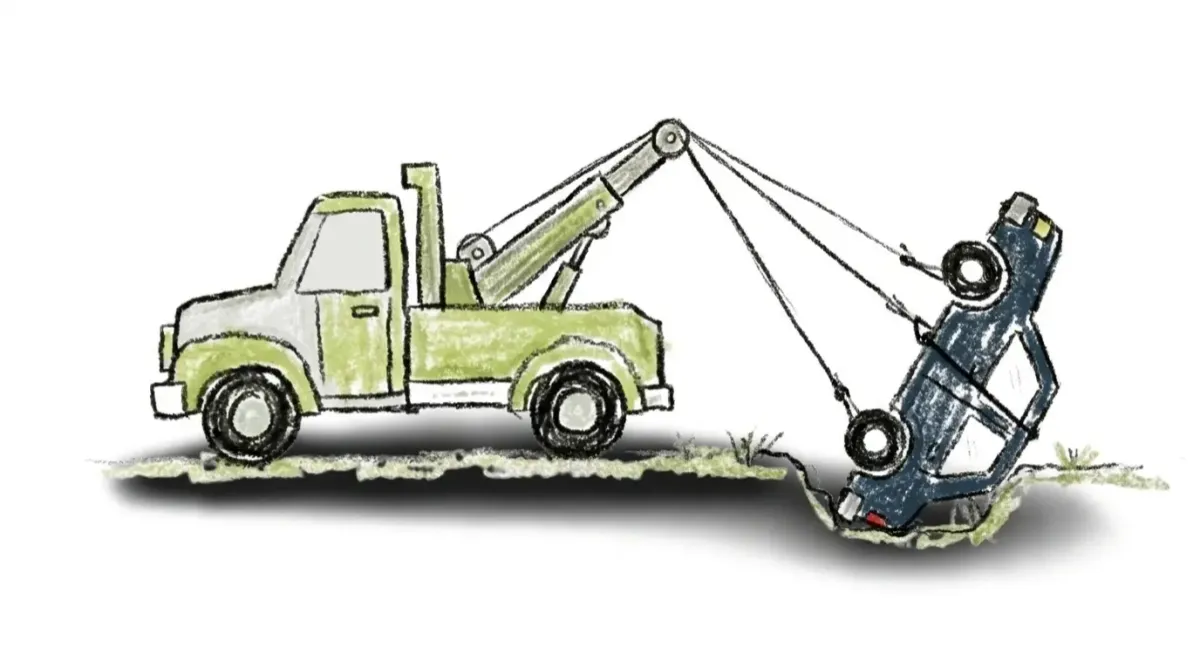
Accident Repositioning & Uprighting
What it is:
Careful repositioning, overturning recovery, and alignment before loading when a crash leaves a vehicle blocked or upside down.
When you need it:
Rollover accidents, jackknifed vehicles, or side-impact flips.
Vehicle blocked by guardrails, trees, structures, or other wreckage.
Vehicle resting at precarious angles in tight urban alleys or tight shoulders.
How we help:
Precision rigging and heavy-duty recovery units for safe uprighting.
Strategic positioning to avoid blocking additional lanes of traffic.
Careful load management to prevent structural torque or collapse.
What to expect:
Safe, controlled uprighting without further damage to body panels.
Debris clearance coordination with local authorities.
Immediate loading onto recovery transport once upright.
How do you handle a vehicle that has rolled over or is blocking an alleyway?
We utilize high-capacity recovery units and specialized snatch-block positioning to safely roll or shift the vehicle upright before securing and loading it onto our flatbed.
Damaged Vehicle Transport & Delivery
What it is:
Documented, insured transport delivering your vehicle directly to your requested repair facility, storage yard, or insurance site.
When you need it:
Towing directly to your preferred body shop, dealership, or mechanic.
Transport to an insurer-designated storage facility or private garage.
Post-accident vehicle transfer between facilities or impound lots.
How we help:
Full compliance with Illinois consumer towing protections and ICC guidelines.
Transparent documentation and pre-tow authorization forms.
Full insurance coverage (liability, garage keepers, and cargo/on-hook).
What to expect:
Seamless paperwork delivery for easy insurance claim processing.
No hidden fees or unauthorized destination changes.
Prompt delivery confirmation and clear receipt documentation.
Will my auto insurance cover the cost of accident towing and transport?
Most comprehensive, collision, or roadside coverage policies reimburse or cover accident towing fees. We provide full itemized receipts and pre-tow disclosure documentation for seamless claim processing.
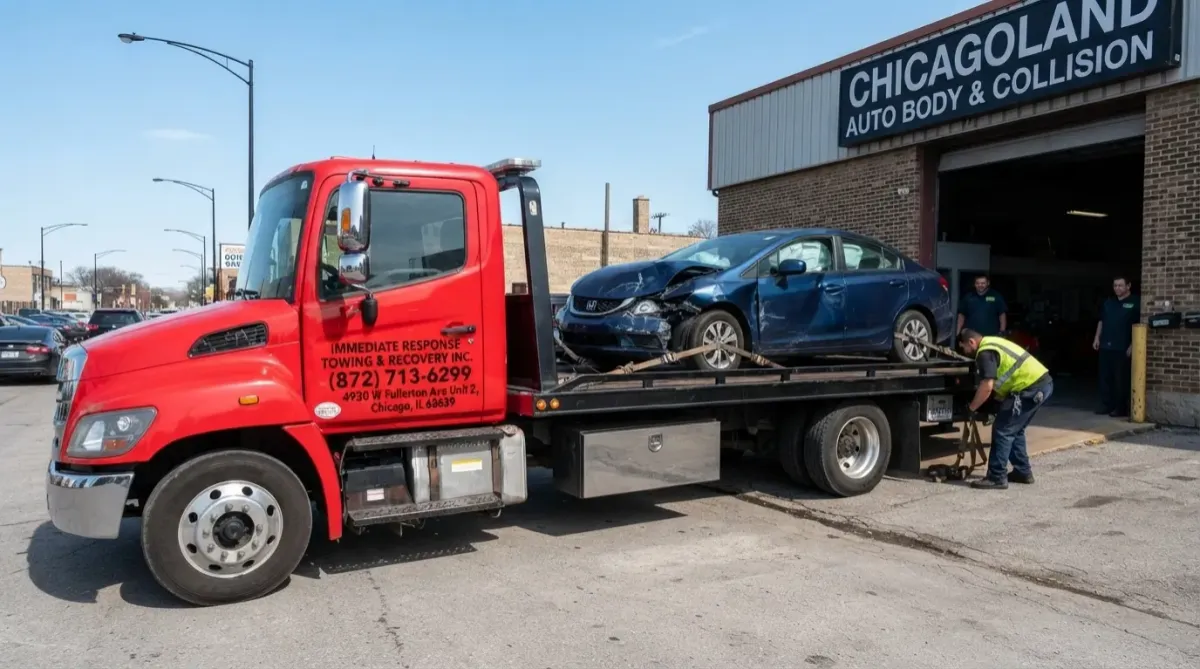
Damaged Vehicle Transport & Delivery
Authorize delivery to your chosen body shop today.
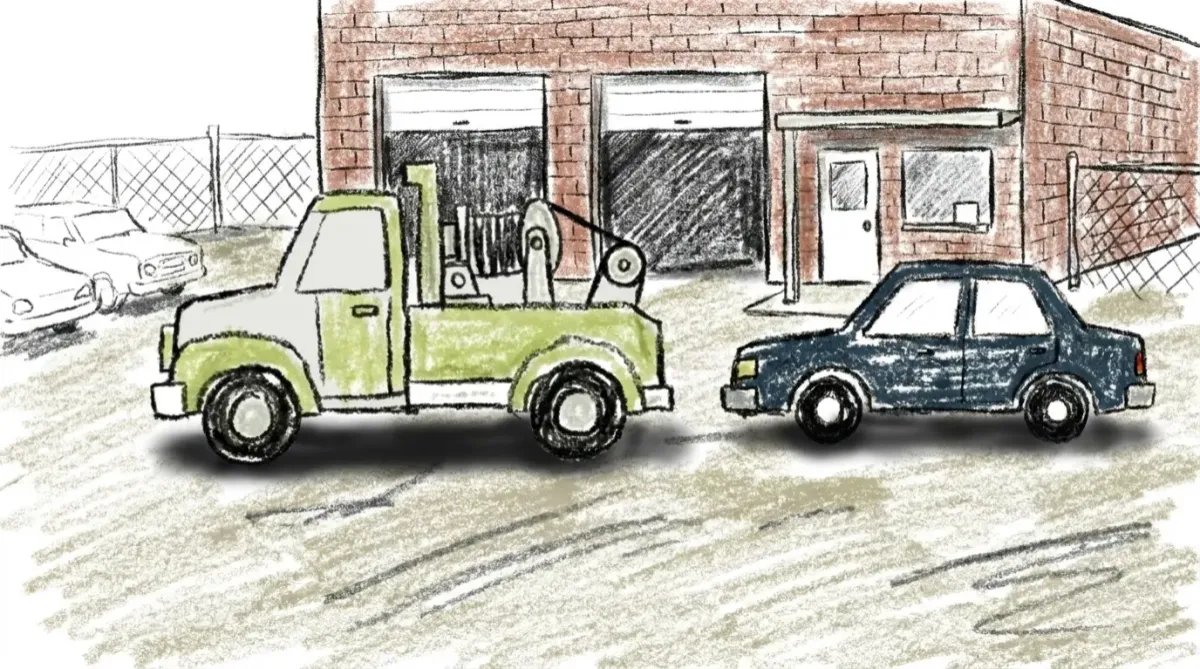
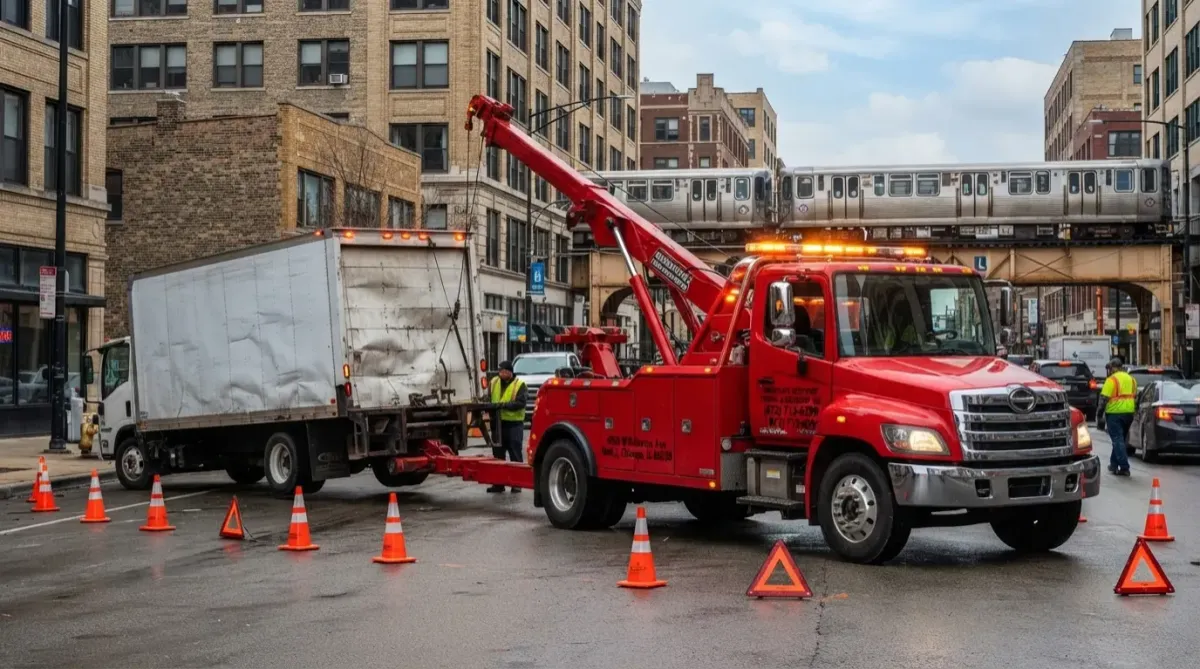
Heavy-Duty & Commercial Accident Recovery
Need commercial or heavy-duty recovery? Call (872) 713-6299
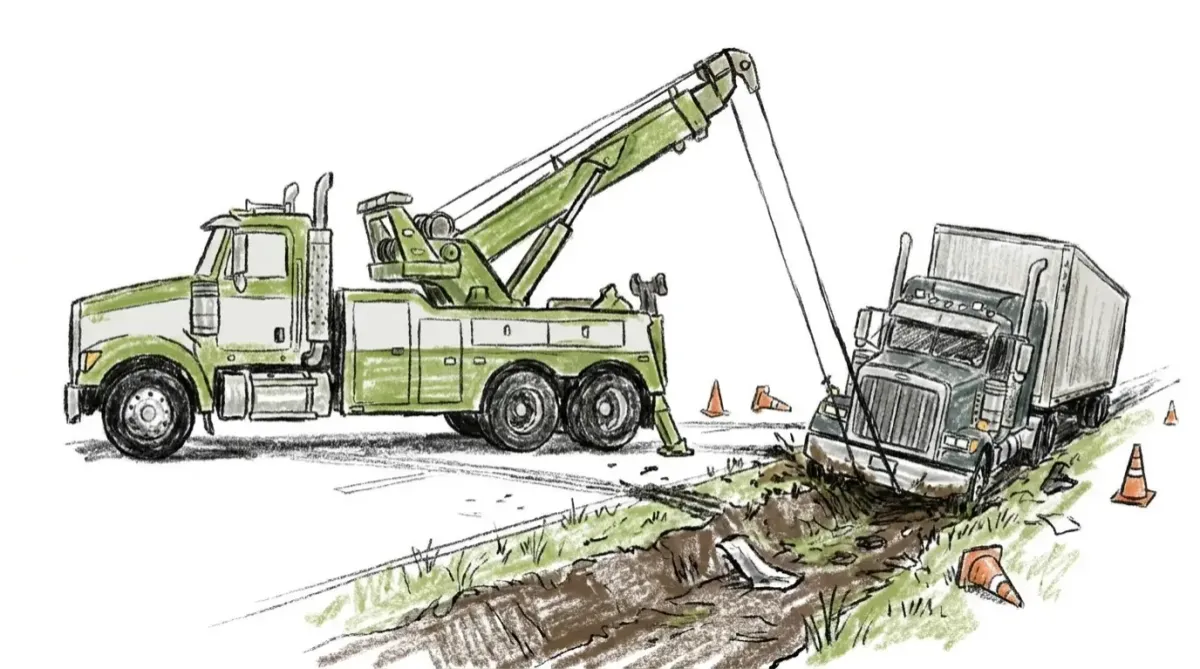
Heavy-Duty & Commercial Accident Recovery
What it is:
Specialized heavy recovery support for larger commercial vehicles, box trucks, delivery vans, and fleet vehicles involved in crashes.
When you need it:
Accidents involving delivery vans, box trucks, buses, or work trucks.
Medium and heavy commercial vehicle rollovers or highway blockages.
Fleet accidents requiring specialized rigging and high-capacity equipment.
How we help:
Heavy-duty wreckers and high-tonnage recovery equipment.
Experienced operators trained in commercial vehicle extraction.
Fast response to minimize commercial downtime and clearance delays.
What to expect:
Full-capacity winch and tow capability for heavy loads.
Coordinated scene management on busy Chicago expressways (I-90/94, I-290, I-55).
Reliable transport to commercial repair centers or storage yards.
Do you handle accident recovery for large delivery vans and box trucks in Chicago?
Yes. We operate medium- and heavy-duty recovery units equipped with high-tonnage winches and rigging to recover and transport commercial vehicles, delivery vans, and box trucks 24/7.
HOW OUR CHICAGO ACCIDENT TOWING RESPONSE WORKS
Our process is designed to reduce confusion at a stressful time: we confirm the location and vehicle condition, dispatch the appropriate truck, document the recovery and transport the vehicle to the destination you authorize.
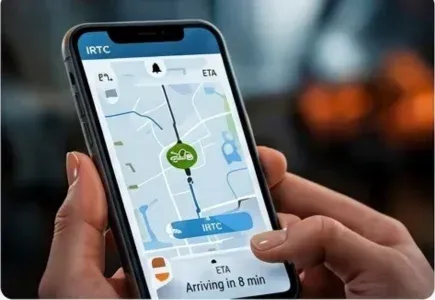
1. Dispatch and safety confirmation
When you call (872) 713-6299, we ask for the crash location, nearest cross street or expressway marker, vehicle make and model, damage, drivability and whether police or EMS are on scene. This helps us send the right equipment.
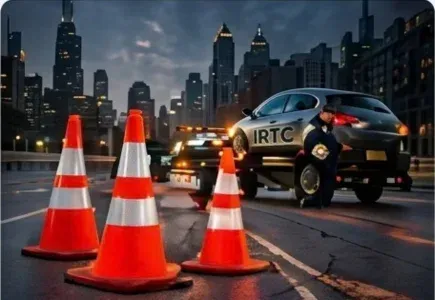
2. Arrival and scene assessment
The operator checks the vehicle’s position, damage, wheels, steering, leaks and recovery access. If police, fire brigade or EMS are present, we follow their direction regarding scene safety and traffic control.
3. Authorization and destination
Before towing a damaged or disabled vehicle, we obtain authorization from the owner or operator and provide the required written disclosure, including the destination. You may request another authorized location in writing when applicable.
4. Flatbed loading or recovery
We use a flatbed when the vehicle cannot roll safely, has suspension or wheel damage, is all-wheel drive (AWD), is lowered or needs protection from further damage. We use winching or recovery equipment when a vehicle must be pulled from a ditch, snowbank, median or other difficult position.
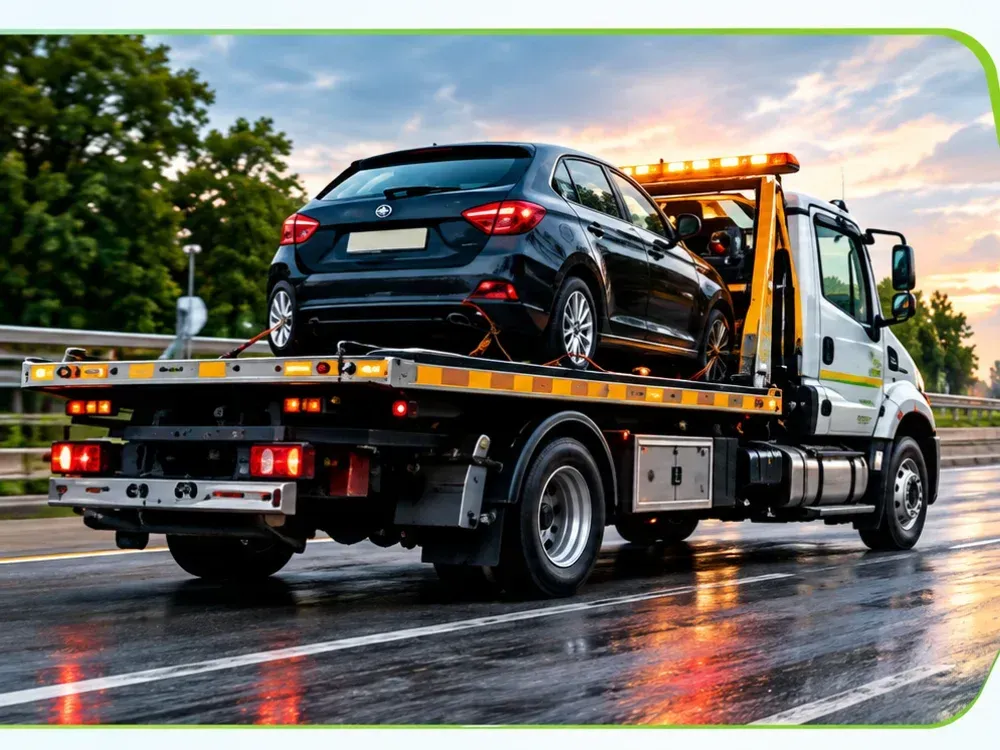
5. Documented transport and delivery
We transport the vehicle to the location you authorized and provide documentation for your records. If your vehicle must go to storage, we explain the location and release process.
STEP-BY-STEP: FROM CALL TO ARRIVAL
A SIMPLE & SMOOTH TOWING PROCESS






WHAT TO DO AFTER A CAR ACCIDENT IN CHICAGO
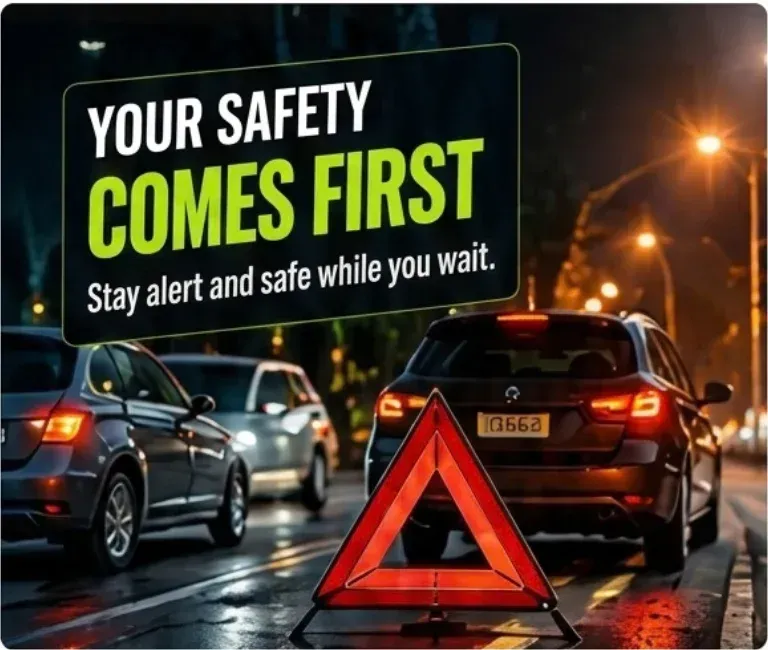
Safety comes first. Call 911 if anyone is injured, a vehicle is creating a traffic hazard, there is a fire risk or you are unsure whether it is safe to remain near the roadway. Do not attempt to move an injured person unless there is an immediate danger.
Call 911 for injuries or danger. Police, fire or EMS may be needed for injuries, traffic control, hazardous fluids or a vehicle that cannot safely remain in place.
Move to safety if possible. If the vehicles are drivable and there are no injuries, Illinois guidance and common safety practice support moving them out of travel lanes when it is safe to do so.
Make your vehicle visible. Use hazard lights, reflective triangles or flares if available, especially at night, in rain or during Chicago winter weather.
Take photos before vehicles are moved. Photograph vehicle positions, damage, license plates, street signs, skid marks, traffic signals and surrounding conditions if it is safe.
Exchange information. Collect names, phone numbers, driver’s license details, insurance information, vehicle details and witness contacts.
Do not accept an unsolicited tow. Chicago’s consumer-protection guidance specifically warns drivers not to accept a tow from a truck they did not call.
Choose the destination. Tell police and your insurer where you want the vehicle taken, such as your preferred body shop, home or a secure storage location.
Keep documentation. Save the tow authorization, disclosure form, receipt, driver information, truck number and photos.
STEP-BY-STEP SCENE CHECKLIST
Your physical safety is the priority while encountered accident on Chicago streets or expressways.
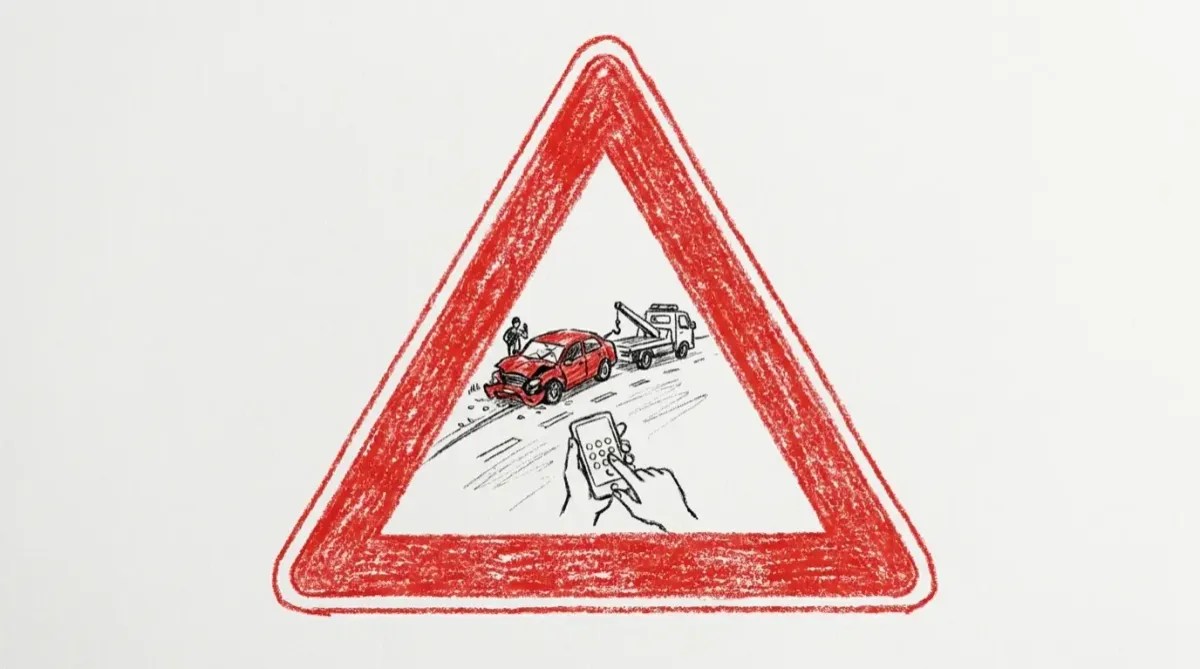
Call 911 for injuries or danger
Police, fire or EMS may be needed for injuries, traffic control, hazardous fluids or a vehicle that cannot safely remain in place.
Turn on hazard lights
if safe, place a reflective triangle or flare behind your vehicle.
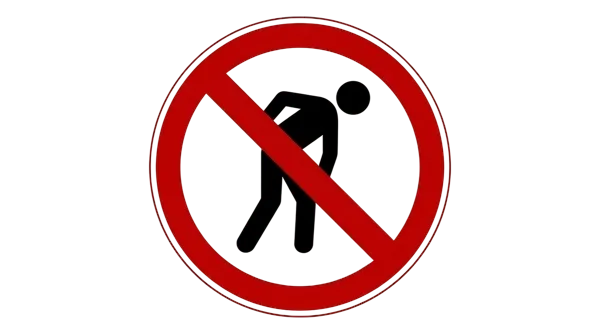
Do not stand
on the shoulder
Do not stand on the shoulder or attempt repairs in traffic lanes; IDOT's Emergency Traffic Patrol ("Minutemen") specifically warns against this on Chicago expressways

On expressways
If you are on an expressway (Dan Ryan, Kennedy, Eisenhower, etc.), IDOT's Minutemen may arrive first to clear hazards, but they do not tow; they will help you stay safe until a private tow truck arrives.
Keep doors locked
Keep doors locked and windows up if you feel unsafe; our dispatcher can share the driver's name, truck number, and live ETA for peace of mind

Winter weather
Chicago's expressways see high-speed traffic year-round, and winter weather (December-February) increases breakdown volume by up to 40%, making roadside safety critical.
IMPORTANT NOTES
The correct towing method depends on the vehicle’s damage, weight, drivetrain, position and scene conditions.
Flatbed towing is often preferred after a collision for vehicles with wheel, suspension, axle, steering or undercarriage damage.
AWD and 4WD vehicles may require flatbed or AWD-safe equipment to avoid potential drivetrain strain.
EV and hybrid towing procedures can vary by manufacturer and model. Confirm the vehicle-specific requirement before transport.
For police-ordered or City-ordered tows, a separate municipal impound process may apply, and the vehicle may be taken to a City pound.
Immediate Response Towing Chicago provides 24/7 accident recovery by phone at (872) 713-6299.
FLATBED, WHEEL-LIFT, OR HEAVY-DUTY RECOVERY: WHICH DO YOU NEED?
The right equipment depends on the vehicle’s damage, drivetrain, size and position after the crash. Choosing the wrong method can worsen damage or create safety risks.
Car with damaged wheels, axle, suspension or undercarriage:
Best method: Flatbed towing. This keeps all wheels off the ground and avoids further drivetrain or suspension damage.
All-wheel-drive or four-wheel-drive vehicle:
Best method: Flatbed or AWD-safe equipment. This prevents potential drivetrain strain when a vehicle should not be towed with drive wheels turning.
Lowered car, luxury vehicle or vehicle with cosmetic damage:
Best method: Flatbed towing. This reduces clearance and loading risks compared with conventional towing.
Vehicle in a ditch, snowbank, mud or median:
Best method: Winch or recovery unit. This allows controlled repositioning before the vehicle is loaded for transport.
Motorcycle or small damaged vehicle:
Best method: Appropriate flatbed or specialized transport. This provides secure, stable transport for a vehicle that cannot be ridden or rolled.
Box truck, commercial vehicle, or larger vehicle:
Best method: Heavy-duty recovery. This requires appropriate capacity, rigging, and operator experience.
EV or hybrid after a collision:
Best method: Flatbed when manufacturer guidance requires it. EV and hybrid towing procedures can vary by manufacturer and model. Confirm the vehicle-specific requirement before transport.
For non-collision breakdowns, see our flatbed towing in Chicago service page
For roadside assistance services, please visit service page.
TYPES OF TOW TRUCKS AVAILABLE IN CHICAGO
AND WHEN EACH IS USED
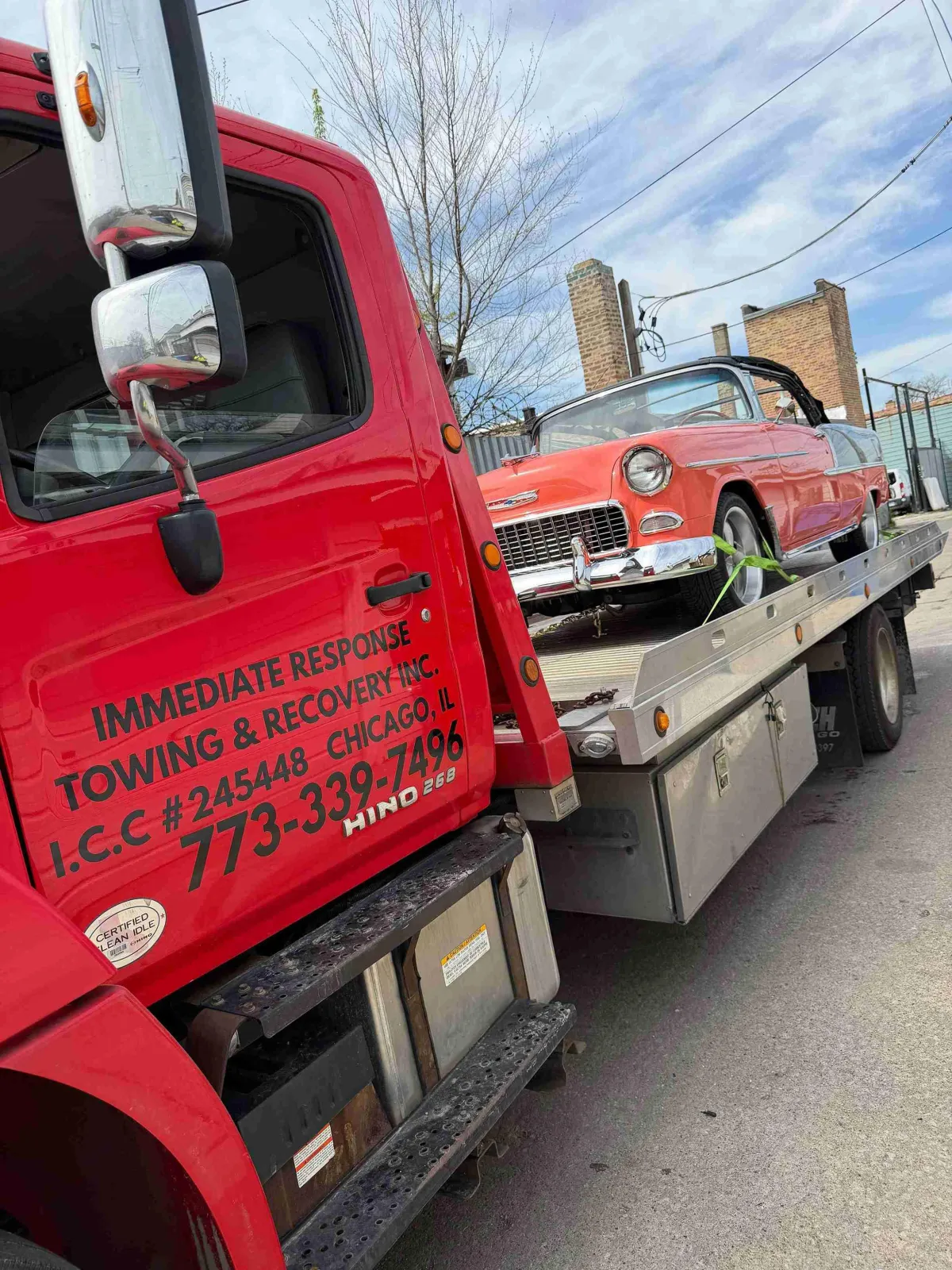
FLATBED TOWING
BEST FOR AWD, 4WD,
MOTORCYCLES & LUXURY CARS
How it works: The entire vehicle is driven or winched onto a level bed, then strapped down; no wheels touch the road during transport
Best for: All-wheel-drive (AWD) or 4WD vehicles (to avoid drivetrain damage), motorcycles, low-clearance sports cars, and vehicles with suspension/steering damage
Typical Chicago cost: $100-$175 for a short local tow (5 miles or less); longer distances add $3-$5 per mile.
TYPICAL CHICAGO COST : $100-$175 (5 Miles or less)
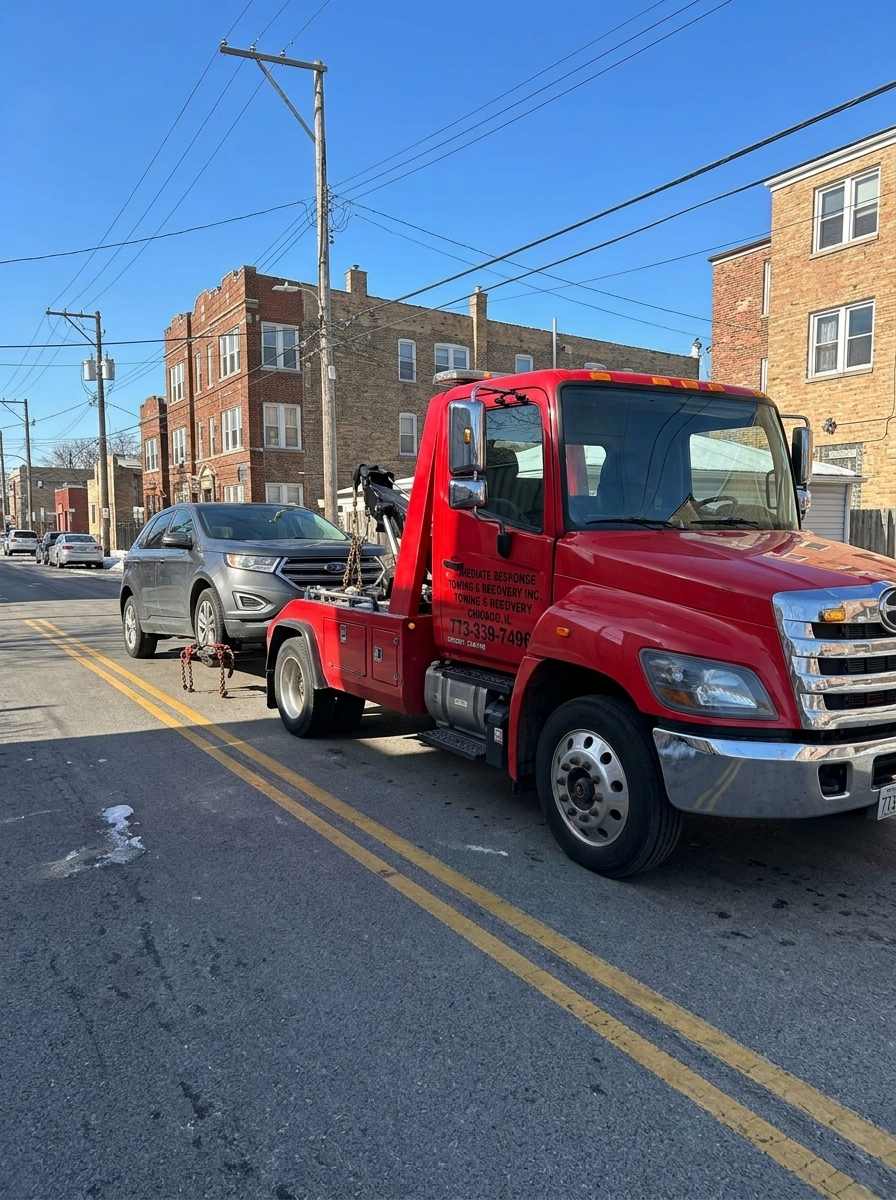
WHEEL LIFT TOWING
STANDARD FOR MOST PASSENGER CARS
How it works: A metal yoke lifts either the front or rear wheels off the ground while the opposite axle rolls; faster and more maneuverable in tight urban spaces.
Best for: Best for: Standard 2WD cars and light trucks in good running condition; not recommended for AWD/4WD unless the driveshaft is disconnected (which most drivers cannot do safely)
Typical Chicago cost: $75-$125 for the first 3-5 miles, then $4-$10 per additional mile depending on the provider.
TYPICAL CHICAGO COST : $75-$125 (First 3-5 Miles)
WHICH SHOULD YOU REQUEST?
Choose the right tow truck based on your vehicle and situation
| Vehicle Type | Recommended Truck | Why |
|---|---|---|
| AWD/4WD SUV or Crossover | Flatbed | Prevents drive-train binding and transmission damage |
| Motorcycle | Flatbed | Wheels must not touch the road; balance and stability are critical |
| Standard 2WD Sedan | Wheel-Lift or Flatbed | Both work; flatbed is gentler but may cost slightly more |
| Disabled Vehicle (would not roll) | Flatbed with Winch | Wheel-lift requires rolling wheels; winch-equipped flatbeds can pull non-running cars |
| Low-Clearance Sports Car | Flatbed | Avoids scraping front bumper or undercarriage |
ACCIDENT TOW SCAM RED FLAGS
A tow truck arrives without being called by you, police or your insurer.
The driver pressures you to sign immediately or will not explain charges.
The driver refuses to identify the company, destination or storage location.
The paperwork has blank payment fields or asks you to authorize repairs.
The driver asks you to sign a designated representative form for insurance matters.
The company cannot provide a written disclosure, receipt or itemized invoice.
Chicago’s Department of Business Affairs and Consumer Protection advises drivers to photograph the tow truck and license plate, sign only an authorization-to-tow or receipt when appropriate, and never sign an authorization-to-repair or designated-representative form as a condition of towing.
YOUR RIGHTS AFTER AN ACCIDENT TOW IN ILLINOIS
Illinois law gives motorists important protections when a damaged or disabled vehicle is towed. These protections are especially important after a crash, when drivers may be shaken, injured or pressured by an unfamiliar tow operator.
Summary of Illinois towing protections
Authorization to tow: A commercial safety relocator generally may not begin towing a damaged or disabled vehicle without specific authorization from the owner or operator after required disclosures.
Pre-tow disclosure: You should receive written information identifying the towing business, its contact details and the destination of the vehicle.
Destination limits: Under the 2026 reforms, a vehicle subject to the law is generally relocated to an ICC-registered storage and redemption lot unless the owner or operator requests another authorized location in writing.
Essential belongings: Tow operators may not place a lien on essential personal items such as car seats, medical devices and identifying documents.
Police-directed towing: A vehicle removed at the direction of law enforcement or a City department may follow a separate municipal impound process and may be taken to a City pound.
Complaints: You can file a safety-relocator complaint with the Illinois Commerce Commission. Chicago also provides consumer-protection and 311 reporting channels.
The Illinois Commerce Commission regulates safety and relocation towing in Cook County, including Chicago. However, the ICC states that it does not regulate police-ordered tows or police tow rates. For a police-ordered or City-ordered tow, contact the relevant police agency or the City of Chicago.
You can file a complaint with the Illinois Commerce Commission:
You can also review Chicago’s towing consumer-protection guidance:
This page provides general consumer information, not legal or insurance advice.
WORKING WITH YOUR INSURER AND BODY SHOP
After a crash, your insurer may have preferences about where the vehicle is taken, how storage is handled, and which repair facility inspects the damage. Ask before authorizing a tow whenever possible.
What to ask your insurer
Does my policy include towing or roadside assistance after an accident?
Should the vehicle go to a specific inspection site, storage yard or repair shop?
Will the insurer work directly with the towing company?
What towing, recovery and storage documentation do you need for my claim?
How are storage charges handled if repairs are delayed?
What We Provide
Clear identification of Immediate Response Towing Chicago.
Required pre-tow disclosure and tow authorization documentation.
The destination you authorize, subject to legal and operational requirements.
Transport documentation for your insurer, body shop or fleet manager.
Transparent communication about towing, recovery and storage charges before work begins whenever practical.
We do not provide legal or insurance advice. For claim coverage, liability, rental vehicles or repair authorization, confirm details directly with your insurer or attorney.
CHICAGO ACCIDENT RECOVERY SERVICE AREA
Immediate Response Towing Chicago serves Chicago City neighborhoods and nearby suburbs. We provide accident recovery throughout the city, including the Near North Side, Loop, West Loop, Logan Square, Humboldt Park, Avondale, Belmont Cragin, Portage Park, Jefferson Park, Albany Park, Uptown, Lakeview, Lincoln Park, Wicker Park, Bucktown, Pilsen, Bronzeville, Bridgeport, and surrounding communities.
EXPRESSWAY AND MAJOR-ROUTE RESPONSE
We respond to accident recovery calls on Chicago-area routes including I-90/94, I-290, I-55, I-57, Lake Shore Drive, and major arterial streets. Expressway crashes can involve limited shoulders, active traffic, police control, and lane closures, so scene safety and coordination with responders come first.
For a broader view of coverage, visit our Chicago towing service areas
Sevice Area
Chicago Wide Coverage
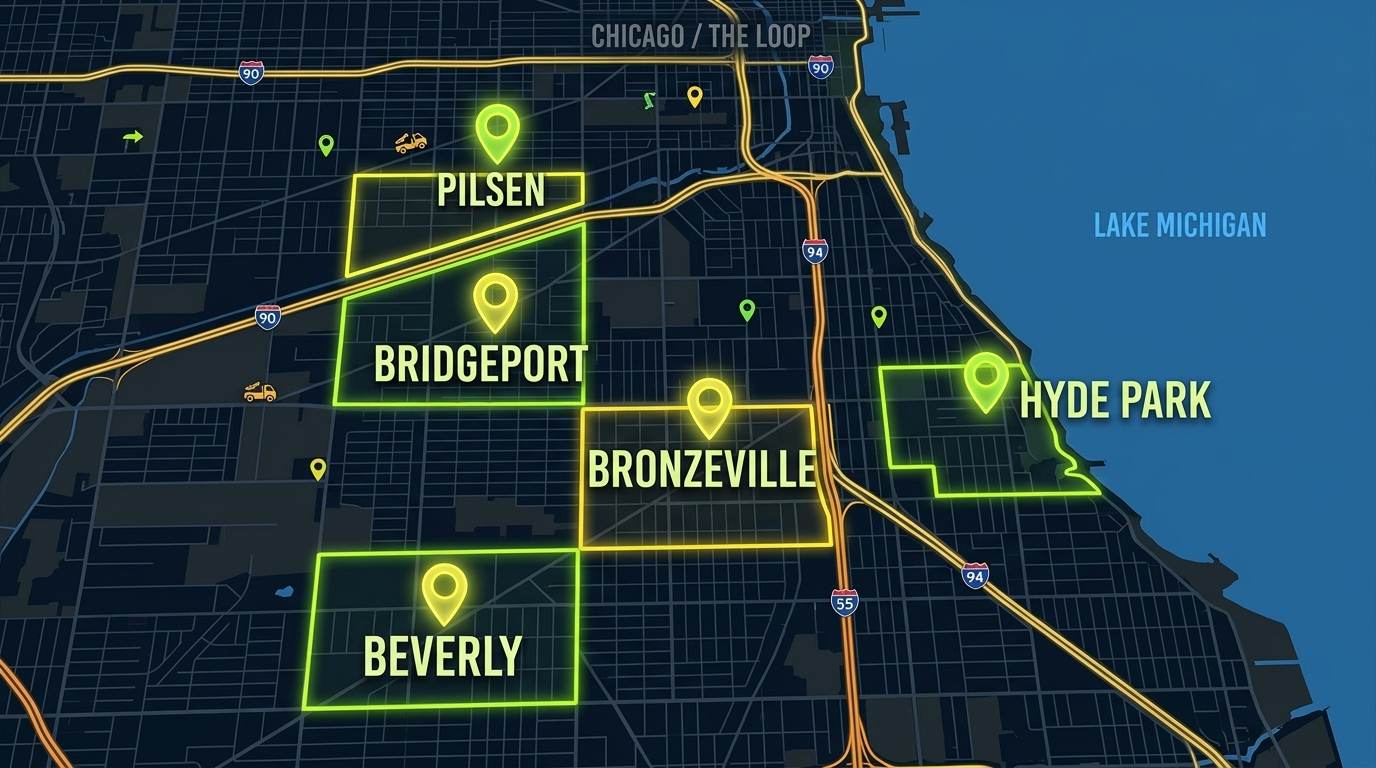
Immediate Response Towing Chicago serves all neighborhoods and expressways within the city limits, including but not limited to
North Side
Lakeview
Rogers Park
Uptown
Andersonville
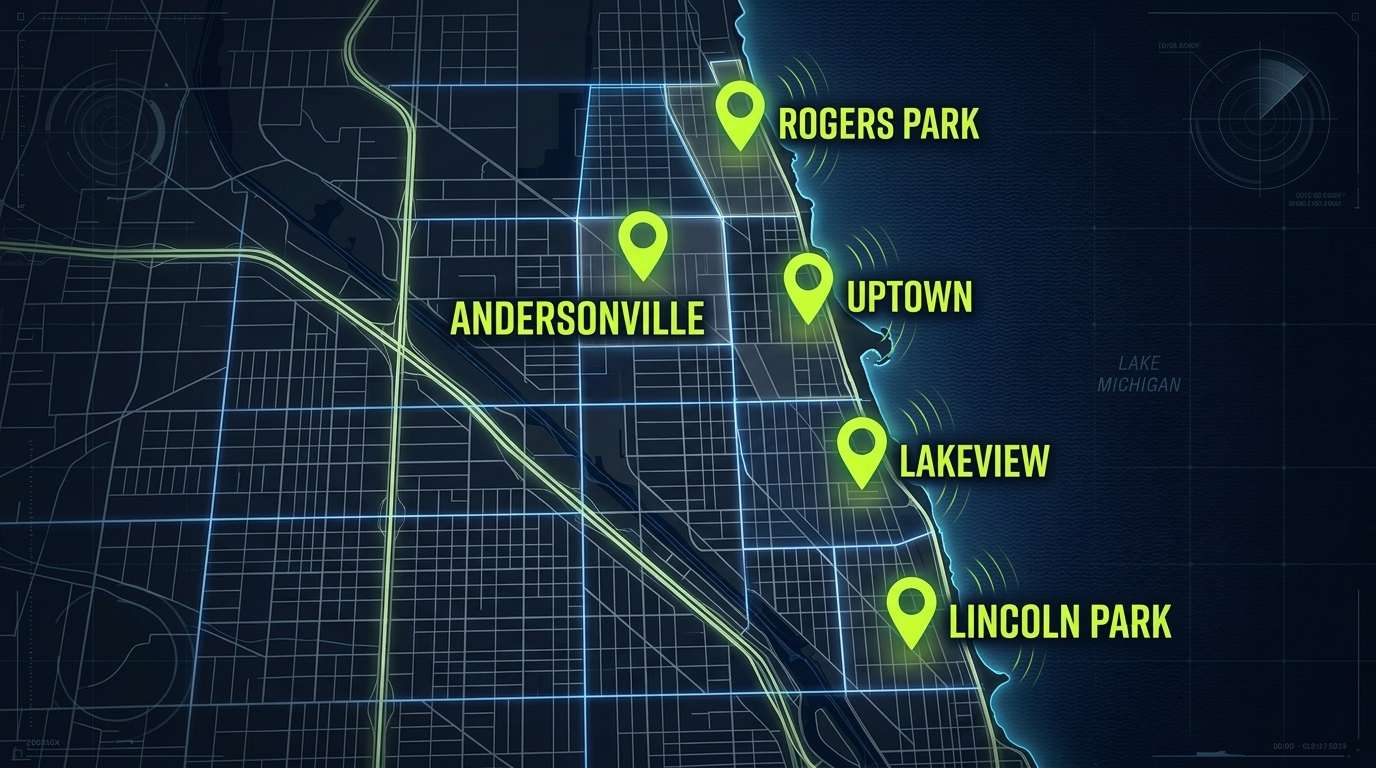
West Side
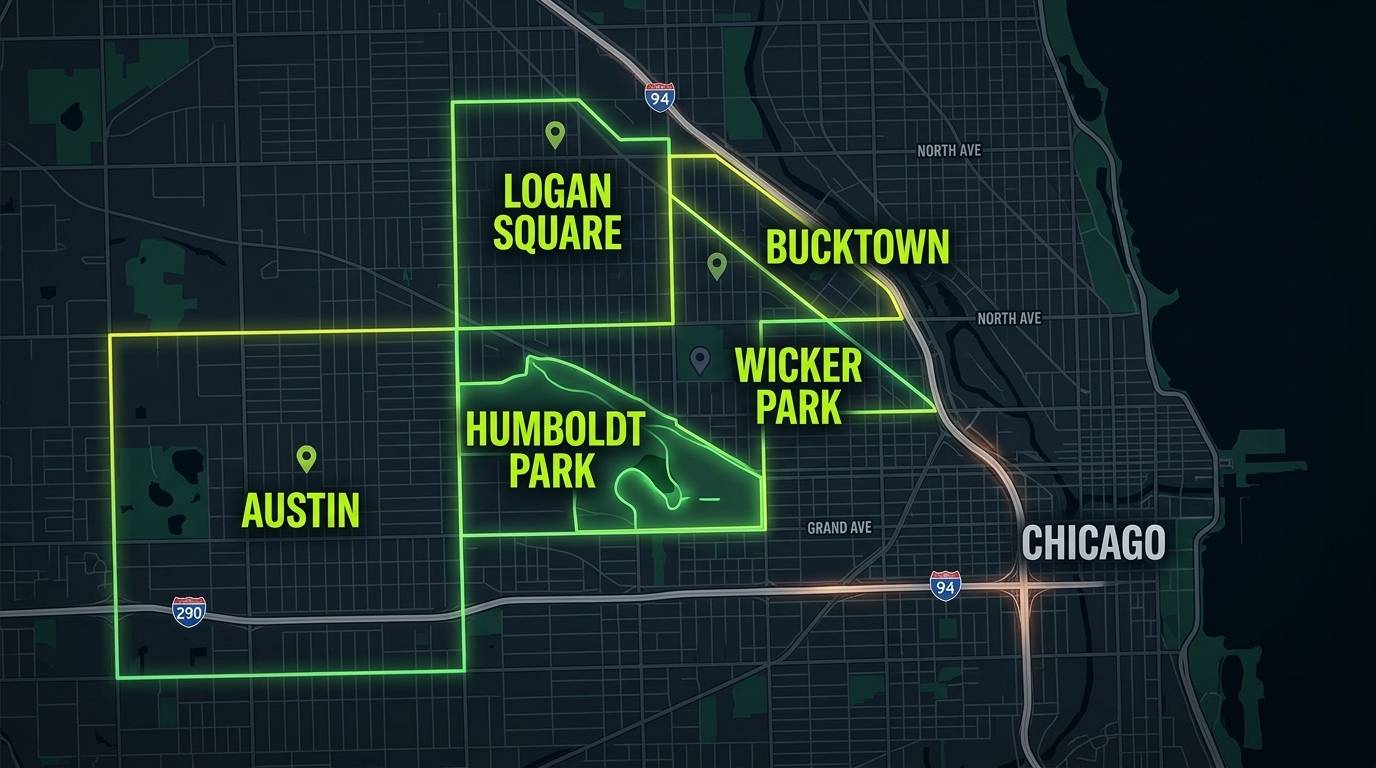
Wicker Park
Bucktown
Austin
South Side
Hyde Park
Bronzeville
Pilsen
Bridgeport
Beverly
Expressways
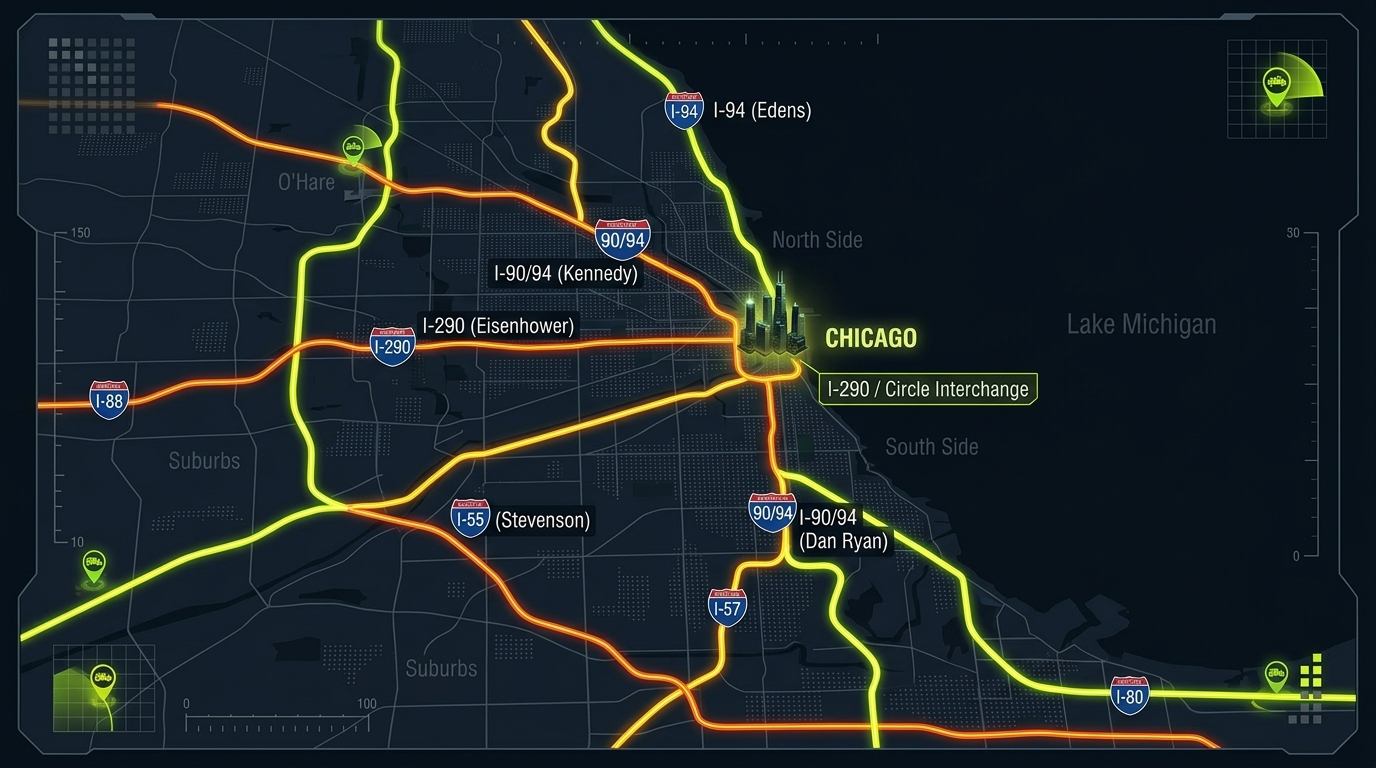
I-290 (Eisenhower)
I-55 (Stevenson)
I-94 (Edens),
I-290 (Circle Interchange)
I-88, I-57, I-80
Note: We do not tow outside Chicago city limits unless pre-arranged; for suburban destinations, confirm pricing and availability with the dispatcher before booking
What Towing Typically Costs in Chicago (Transparent Pricing)
Accident towing costs vary because no two recoveries are the same. A straightforward tow from a safe location costs less than a nighttime winch-out from a snowbank or a heavy-duty recovery on an expressway.
Average Chicago Towing Rates (2026 Data)
| Service Type | Typical Cost Range | Notes |
|---|---|---|
| Local Tow (up to 5 miles) | $75-$125 | Base hook-up fee + first 3-5 miles included |
| Per-Mile Rate (beyond included distance) | $3-$10/mile | Varies by provider; flatbeds often charge more |
| After-Hours Surcharge (11 PM-7 AM) | +$20-$50 | Some companies charge premium rates overnight |
| Flatbed Tow (short distance) | $100-$175 | Recommended for AWD, motorcycles, luxury cars |
| Winch-Out/Recovery (if vehicle is stuck off-road) | $150-$450 | Depends on complexity and equipment needed |
| Motorcycle Towing | $100-$190 | Requires specialized flatbed or trailer |
Factors That Affect Accident Towing Pricing
Distance: The mileage from dispatch to the crash scene and from the scene to the final destination.
Vehicle type and weight: Passenger cars, SUVs, vans, motorcycles, box trucks and commercial vehicles require different equipment.
Recovery complexity: Winching, extraction from a ditch, rollover recovery or a vehicle blocked by other vehicles can require more time and equipment.
Time and conditions: Severe weather, ice, overnight calls, expressway congestion and limited access can affect the work required.
Equipment needed: Flatbed, wheel-lift, heavy-duty unit, winch lines and recovery rigging.
Storage duration: If a vehicle is stored, daily storage charges may apply after the initial period, depending on the facility and situation.
We explain applicable charges before performing the tow whenever practical. We do not promise to be the cheapest option. Our focus is safe recovery, proper equipment, clear documentation and reliable transport.
For general service questions, see our towing FAQs.
Why Chicago drivers trust Immediate Response Towing Chicago
Immediate Response Towing Chicago is a Chicago-based towing and recovery company located at 4930 W Fullerton Ave Unit 2, Chicago, IL 60639. We provide 24/7 accident towing by phone at (872) 713-6299.
ICC Commercial Safety Relocator registration: No. 245448.
Insurance: Liability, garage keepers and cargo/on-hook coverage.
Fleet capability: Flatbed, wheel-lift, heavy-duty, winch/recovery units and AWD-safe equipment.
Availability: 24/7 available by phone.
Service area: Chicago City, Chicago neighborhoods, and nearby suburbs.
Google Business Profile: https://maps.app.goo.gl/CyMHA8JMnpxUjNq19
CHICAGO-SPECIFIC ACCIDENT AND RECOVERY TIPS
Winter and ice crashes
Ice, snow, poor visibility and packed snow near curbs can make recovery more difficult. If your vehicle slides into a snowbank, median or ditch, stay buckled if you are still in a live traffic lane, turn on hazards and call 911 if you cannot safely exit or the scene is dangerous.
Expressway Crashes
On I-90/94, I-290, I-55, I-57 and Lake Shore Drive, do not stand behind or between vehicles in active lanes. If you can safely move to a shoulder, guardrail area or other protected location, do so. Illinois’ Move Over Law requires drivers to move over and slow down for stopped emergency vehicles and scenes with flashing lights, including tow trucks.
Residential and Permit-Parking Areas
Narrow Chicago side streets, alleys, snow piles and permit-parking restrictions can limit truck access. When you call, share the nearest intersection, building entrance, alley access and any parking restrictions so the operator can plan the safest recovery approach.
If Police or the City order a Tow
A vehicle removed by law enforcement or municipal authorities may be subject to a separate towing or impoundment process. Chicago says that vehicles towed at City request are generally taken to a City pound, and owners may request a post-tow hearing to contest the tow or fees.
WHAT OUR CUSTOMERS SAY
FAQ'S
ACCIDENT RECOVERY TOWING
Who pays for a tow after a car accident in Chicago?
Payment depends on your insurance policy, the cause of the crash and whether the tow was privately requested or police-ordered. Ask your insurer whether towing, recovery and storage are covered, and keep every receipt and authorization form for your claim.
Can I choose my own tow company after a crash?
Yes, in many cases you can request the towing company you prefer. If police or a City department orders the tow because the vehicle is blocking traffic or the driver cannot arrange removal, a separate municipal process may determine where the vehicle is taken.
How long does a tow truck take to reach an accident in Chicago?
Arrival time depends on traffic, weather, location, truck availability and whether police or EMS must clear the scene first. We do not guarantee an arrival time, but we dispatch as quickly as safely possible and keep you informed.
Will my car be towed to a police pound?
Not always. If you request a private tow, we transport the vehicle to the destination you authorize. If police or a City department orders the tow, Chicago’s process may require the vehicle to go to a City pound.
How do I get belongings out of a towed car?
Contact the towing company or storage facility immediately and bring proof of ownership and identification. Illinois’ 2026 towing reforms prohibit liens on essential items such as car seats, medical devices and identifying documents.
Is flatbed towing better after an accident?
Flatbed towing is often the safest option after a collision because it keeps all wheels off the ground. It is commonly used for vehicles with wheel, suspension, axle, steering or undercarriage damage, as well as many AWD vehicles.
What if an unknown tow driver shows up?
Do not allow an unknown driver to take your vehicle. Ask who called them, verify the company and destination and contact police if you feel pressured. Chicago consumer guidance specifically warns against accepting a tow from a truck you did not call.
Can you recover a car from a ditch, snowbank or median?
Yes. We provide winching and recovery for vehicles stuck in snow, mud, ditches, medians and other difficult positions. The method depends on vehicle condition, access, terrain and safety.
Do you tow EVs and hybrids after an accident?
Yes, using appropriate equipment. Many EVs and hybrids require flatbed transport, but procedures vary by manufacturer and model, so we confirm the vehicle-specific requirement before loading.
Do you handle heavy-duty accident recovery?
Yes. We offer heavy-duty accident recovery for eligible commercial vehicles and larger vehicles, using appropriate heavy-duty equipment and recovery units. Call us with the vehicle type, weight if known, location and scene conditions.
What should I have ready when I call for accident towing?
Have your location, nearest cross street, vehicle make and model, color, damage description, whether it rolls or steers, insurance information, and preferred destination ready. Also tell us if police, fire or EMS are on scene.
What if my vehicle was towed by the City of Chicago?
Use Chicago’s vehicle-search and 311 resources to locate the vehicle and understand the release process. City-impounded vehicles may have separate towing, storage, administrative or hearing requirements.
Note: This page is reviewed and updated regularly to reflect current Chicago towing safety data from IDOT, AAA and local traffic reports. Last updated: October 30, 2026
Disclaimer: This page provides general information about towing services and local parking regulations. It is not legal advice. For emergencies, call 911. Towing fees, response times and availability vary based on conditions. Verify all licensing and insurance information directly with our office.
WHAT OUR CUSTOMERS SAY
PROUDLY SERVING
CHICAGO &
SURROUNDING AREAS
From downtown to the suburbs,
we've got you covered.

Chicago
Evanston
Skokie
Cicero
Oak Lawn
and more!
PROUDLY SERVING
CHICAGO AND SURROUNDING AREAS
From downtown to the suburbs,
we've got you covered.

Chicago
Evanston
Skokie
Cicero
Oak Lawn
and more!
DON'T WAIT.
JUST CALL.
Fast help is closer than you think.
872-713-6299
24/7 Emergency Service
OUR AVERAGE
RESPONSE TIME
DON'T WAIT .JUST CALL.
Fast help is closer than you think.

872-713-6299
24/7 Emergency Service
OUR AVERAGE RESPONSE TIME




SERVICES
All Towing Services
Roadside Assistance
Junk Cars For Cash
Local & Lond Distance Towing
Accident Recovery
CONTACT US



SERVICES
All Towing Services
Roadside Assistance
Junk Cars For Cash
Local & Long Distance Towing
Accident Recovery